
The objective of this practice is to accurately identify the extent of power loss and monitor the chronological power restoration process in disaster-affected regions. This information can be used by government authorities, disaster management agencies, and humanitarian organizations to guide timely rescue efforts, allocate relief resources, and evaluate long-term infrastructure resilience.
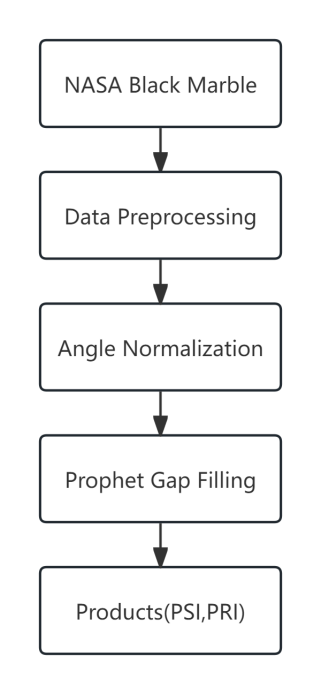
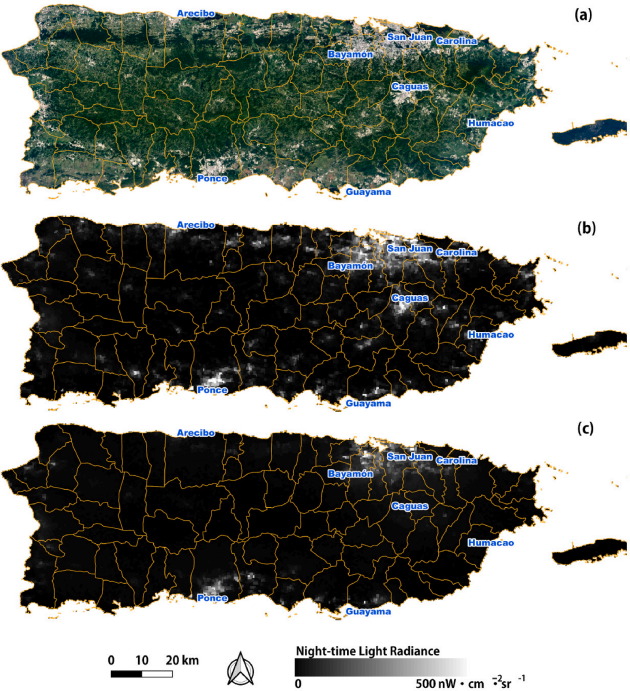
The Recommended Practice was initially applied to power outages caused by Hurricane Maria in Puerto Rico (2017) using daily night-time light data, and was subsequently utilized to assess the 2023 Kahramanmaraş Earthquake in Turkey and the 2023 Monsoon Floods in Pakistan. The disaster impacts were extracted from VIIRS Black Marble products (VNP46A1/A2) by utilizing an angular normalization algorithm and the Prophet model to ensure temporal continuity. Power disruption and recovery trajectories were assessed by calculating the Power Supply Index (PSI) and Power Restoration Index (PRI), which were further correlated to estimate regional GDP loss rates. The analysis specifically targets urban built-up areas extracted from 30-meter GlobeLand30 data and works best for regions with established electrical infrastructure.
Related Data:
- VIIRS Daily Black Marble Product Suite (NASA)
- GlobeLand30 Land Cover Dataset (National Geomatics Center of China, NGCC)
Wuhan University contact:
Dr. Xi Li
Professor, State Key Laboratory of Information Engineering in Surveying, Mapping and Remote Sensing , Wuhan University
Deputy Director, Office of International Affairs, Wuhan University
Research team Webpage: http://nightlight.whu.edu.cn/en
Head, China Regional Support Office, UN-SPIDER
Lead of GEO Initiative - GEO Night Light, Group on Earth Observations
E-mail: li_rs [at] 163.com (li_rs[at]163[dot]com), lixi [at] whu.edu.cn (lixi[at]whu[dot]edu[dot]cn)
This practice can be applied to evaluate power outages caused by sudden natural disasters globally. Because the methodology relies on tracking changes in artificial light emissions, it works best in urban built-up areas with concentrated populations and established electrical infrastructure.