
Who are the users of space-based information and technologies in disaster risk management and emergency response? What are the contexts in which they operate? What are their needs and challenges? The section aims to provide greater insights into these issues.
What is Disaster Risk?
As stated by the United Nations Office for Disaster Risk Reduction (UNDRR), a disaster can be defined as "a serious disruption of the functioning of a community or society involving widespread human, material, economic or environmental losses and impacts, which exceeds the ability of the affected community or society to cope with using its own resources." In the last few decades, societies have become increasingly aware of the fact that disasters can be understood as the result of long-term processes in which risk accumulates over years or decades before a disaster occurs.
Disaster risk arises through the interaction of hazards, exposure, vulnerability and capacity. For several decades, UNDRR and other regional and international organizations have been reporting that disaster risk is influenced by underlying risk drivers such as unequal economic development, poorly planned and managed urban and regional development, the degradation of ecosystem services, poverty and inequality, weak governance, and limited institutional and local capacities.
This section contains information on the basic definitions and processes related to disaster risk management; as well as terminology related to emergency and disaster management, and the role of the UN in these areas.
Disaster Risk Management
According to UNDRR, disaster risk management is the systematic process of using administrative directives, organizations, and operational skills and capacities to implement strategies, policies and improved coping capacities; in order to reduce the adverse impacts of hazards and the likelihood of disasters. When successful, disaster risk management efforts aim to reduce the effects of hazards through prevention, mitigation, preparedness, early warning and resilience measures.
Emergency and Disaster Management
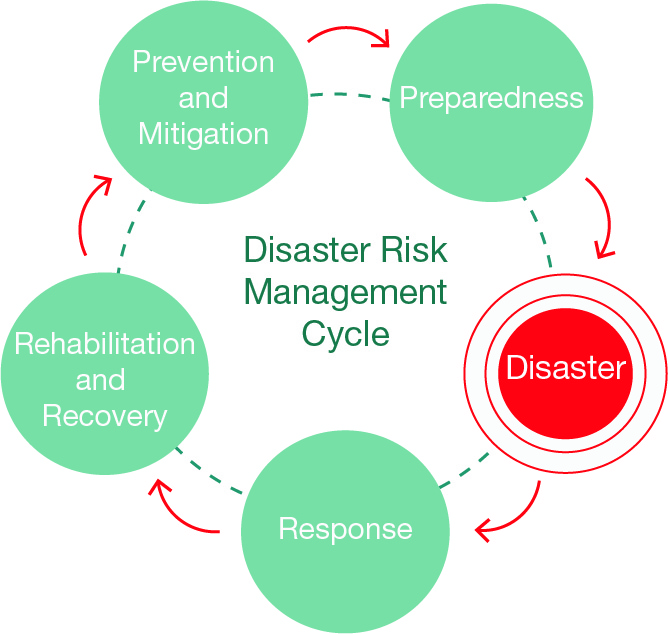
According to UNDRR, disaster risk management focuses on the organization and management of resources and responsibilities to address all aspects of emergencies and disasters; including preparedness, early action, response and initial recovery steps. While emergencies are events that can be managed with local resources, disasters are by definition those events that surpass responders' capacities on the ground to be managed locally, hence requiring external assistance. Emergency and disaster management encompass three main post-disaster phases: response, rehabilitation and recovery. While response and rehabilitation activities typically take place in the days and weeks following a disaster, recovery efforts are conducted in the months and years after the onset and include reconstruction of infrastructure and the restoration of livelihoods. However, the disaster management cycle should not follow a linear sequence. Instead, prevention, mitigation and preparedness activities may occur simultaneously as recovery activities.
Natural Hazards
Natural hazards are defined by UNDRR as natural processes or phenomena that may cause loss of life, injury or other health impacts, property damage, loss of livelihoods and services, social and economic disruption, or environmental damage. Natural hazards can be characterized by their magnitude or intensity, speed of onset, duration, and geographic extent. This section offers a summary of the characteristics, impacts, damage types, emergency actions, mitigation and other measures associated with the different types of natural hazards.
The UN and Disaster Risk Management
Since the early 1990s, the United Nations has been promoting efforts worldwide to promote the implementation of policies and measures aimed at reducing disaster risk before risks materialise into disasters, such as when sudden-onset events like earthquakes and slow-onset hazards such as droughts impact vulnerable communities. The current framework for disaster risk reduction is called the Sendai Framework for Disaster Risk Reduction and outlines four priorities for action that encompass all aspects of disaster risk reduction. This framework was launched during the Third World Conference on Disaster Risk Reduction, which was held in Sendai, Japan from 14 to 18 March 2015. It strengthens resilience by implementing concrete measures to avoid the creation of new risks, reducing the level of existing risks and strengthening the economic and social resilience of communities by addressing the exposure and vulnerability of people and their assets.
The UN and Disaster Management
Since the early 1970s, the United Nations has been providing humanitarian assistance upon official request to countries affected by disasters. As a way to provide such support in a timely and coordinated manner, the United Nations Office for the Coordination of Humanitarian Affairs (OCHA) has established a structured approach that includes the provision of initial technical assistance through the United Nations Disaster Assessment and Coordination teams (UNDAC); the establishment of On-Site Operations Coordination Centres (OSOCC) and Virtual On-Site Operations Coordination Centres (VOSOCC) when necessary; and through the humanitarian cluster system.
