
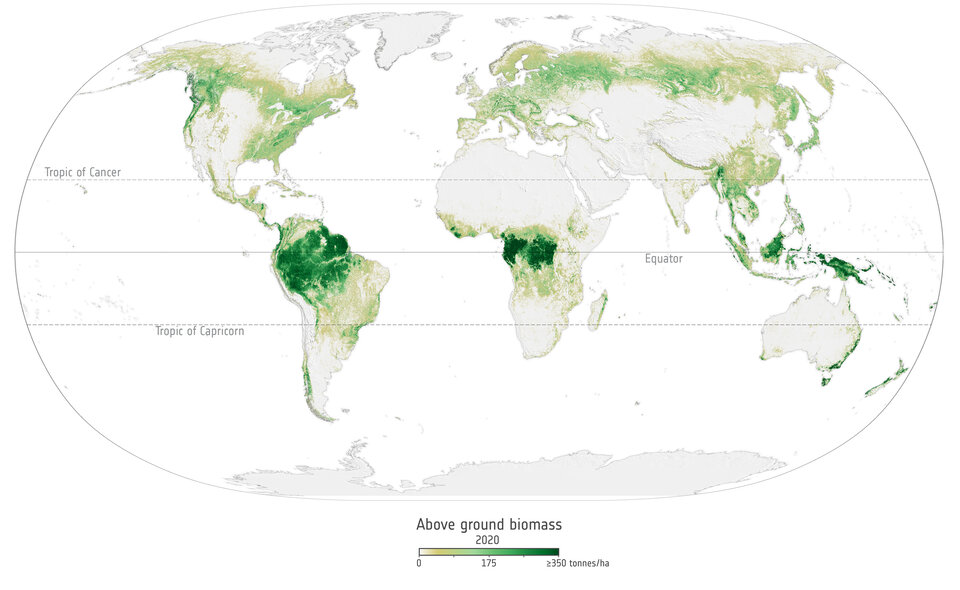
Tropical forests, often described as the planet’s “green lungs,” absorb vast quantities of carbon dioxide, release oxygen, and play a crucial role in regulating Earth’s climate. While widespread deforestation has long been recognised as a major threat, new research identifies a less obvious but highly significant driver of carbon emissions: small-scale forest clearing. Surprisingly, the removal of relatively small forest patches is responsible for more than half of net carbon losses across the tropical regions.
Published in Nature (Small persistent humid forest clearings drive tropical forest biomass losses | Nature), the study presents the most detailed analysis so far of changes in tropical forest carbon stocks caused by disturbances over the last 30 years. Conducted by researchers at France’s Laboratory for Climate and Environmental Sciences (LSCE), who contribute to ESA’s Climate Change Initiative RECCAP-2 and Biomass projects, the research reveals alarming trends.
Using a high-resolution “bookkeeping” method that combines sub-hectare satellite data with advanced models of biomass recovery, the team tracked carbon losses and gains at a 30-metre resolution. Their analysis shows that disturbances in tropical humid forests led to nearly 16 billion tonnes of carbon loss between 1990 and 2020, whereas tropical dry forests experienced a roughly balanced exchange between losses and regrowth.
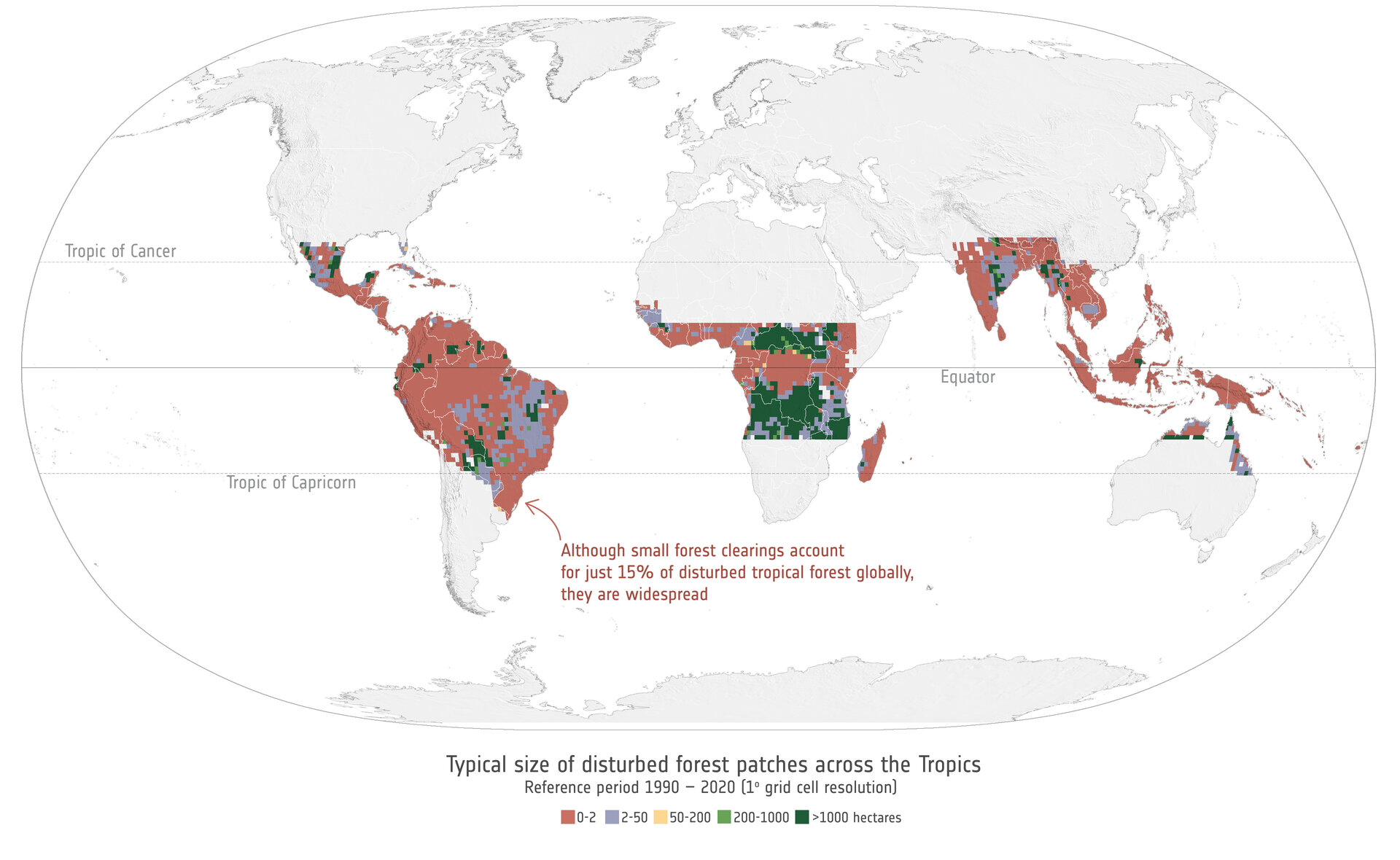
The most striking finding is the outsized impact of small forest clearings. Although these patches—often smaller than two hectares—represent only about 5% of the total disturbed area, they account for 56% of net carbon losses. These disturbances are typically not caused by large-scale logging or major fires, but by incremental human activities such as agricultural expansion, pasture creation, road construction, and settlement growth.
LSCE–Y. Xu/ESALICENCE
CC BY-SA 3.0 IGO or ESA Standard Licence
(content can be used under either licence)
In contrast to dry forests, where vegetation can often regrow after fires and recover some lost carbon, humid tropical forests disturbed by human activity frequently fail to regenerate. As a result, carbon emissions from these areas tend to become permanent.
The study also finds that disturbances are increasingly affecting dense, carbon-rich humid forests, amplifying the climate impact of each hectare lost. This trend differs from dry forests, where repeated fires gradually reduce available fuel and therefore carbon losses per event.
Despite these pressures, intact tropical forests continue to function as a carbon sink, absorbing enough carbon to keep the overall tropical forest carbon balance close to neutral over the three decades studied.
According to lead authors Yidi Xu and Philippe Ciais, the use of high-resolution ESA biomass maps allowed the researchers to capture how disturbance size, type, and local climate influence forest recovery—revealing that small-scale human actions are a dominant but previously underestimated driver of tropical carbon loss.
These findings have important implications for climate policy. In regions such as Africa, where small-scale disturbances are widespread, limiting gradual agricultural expansion could deliver greater climate benefits than previously assumed. The study also underscores the importance of protecting regenerating forests and improving monitoring along forest edges, where the most carbon-dense ecosystems are increasingly at risk.
Beyond highlighting threats, the research provides a valuable tool for policymakers. Its detailed carbon reconstruction can enhance national greenhouse gas inventories, support REDD+ programmes, and help target conservation efforts by identifying where forests are losing or regaining carbon.
ESA officials emphasise that even the smallest forest clearings can have significant climate impacts and that long-term satellite observations are essential for understanding and protecting tropical forests in the face of mounting environmental pressures.
Read the original article here: ESA - Tiny patches of deforestation drive tropical carbon loss
