
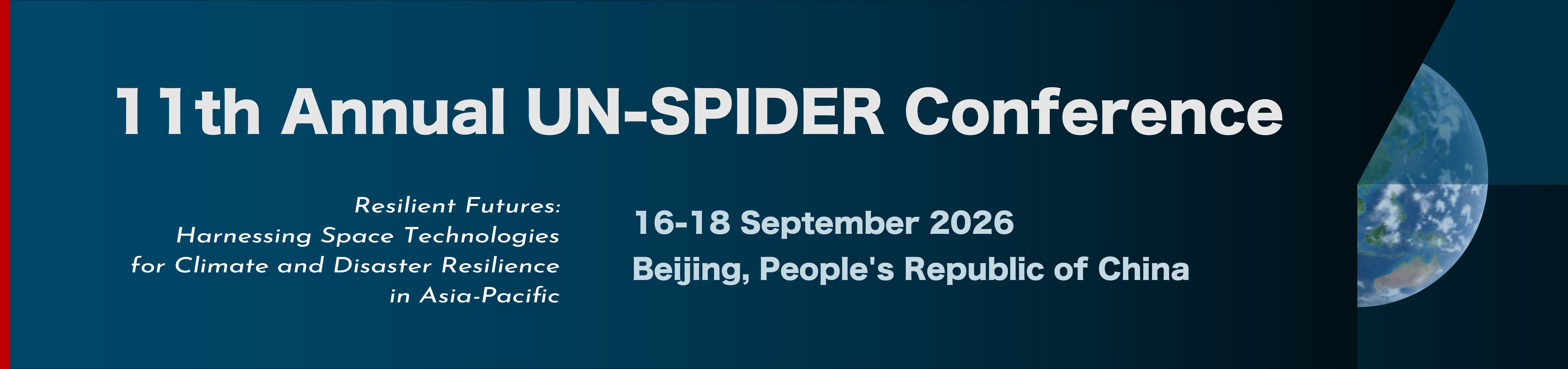
Resilient Futures: Harnessing Space Technologies for Climate and Disaster Resilience in Asia-Pacific
Beijing, People's Republic of China, 14-18 September 2026
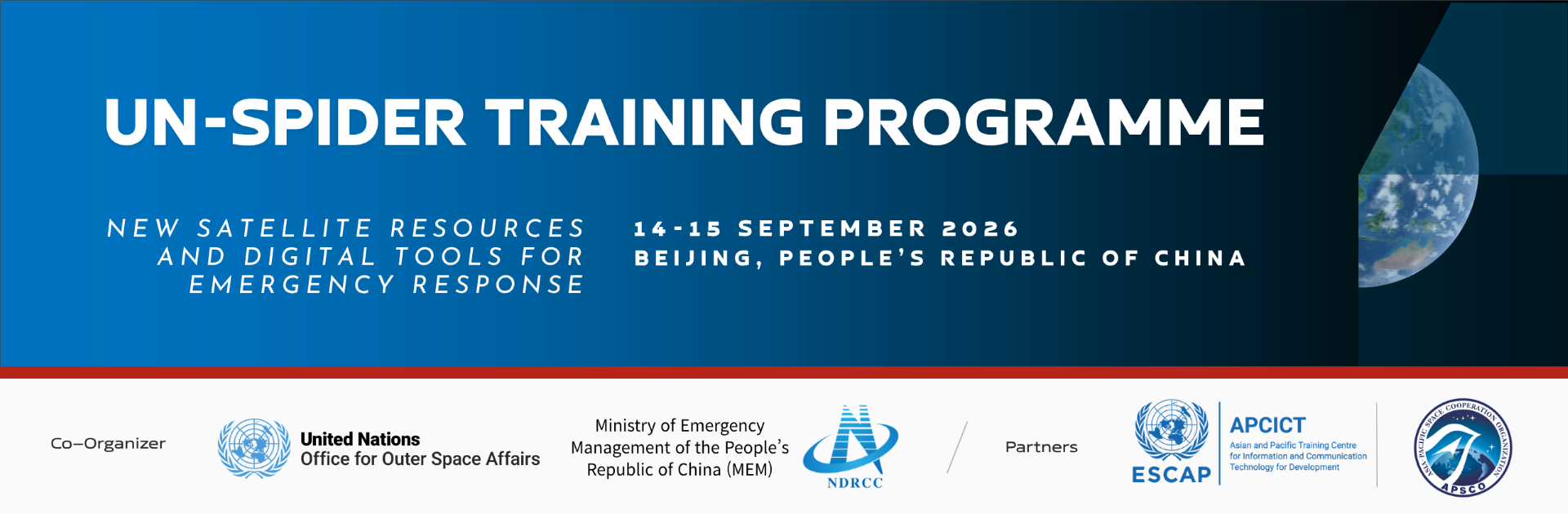
The 11th Annual UN-SPIDER Conference will be held from 16 to 18 September 2026 in Beijing, People's Republic of China. It will be preceded by an UN-SPIDER training programme taking place on 14 and 15 September 2026, also in Beijing. Both events will be held at the Hilton Hotel Beijing. The events are jointly organised by the United Nations Office for Outer Space Affairs (UNOOSA), through its UN-SPIDER programme, and the National Disaster Reduction Centre of China (NDRCC) under the Ministry of Emergency Management (MEM), in partnership with the Asian and Pacific Training Centre for Information and Communication Technology for Development (APCICT), the Asia-Pacific Space Cooperation Organization (APSCO), and the China National Space Administration (CNSA). It is designed for decision-makers and technical staff from national disaster management agencies.
Important Documents
Conference Announcement (TBA)
Information Note (TBA)
Programme Agenda: LINK
Click for Online Application: Application Form: 2026 UN-SPIDER Conference
Application Deadline: 31 May 2026
1. Rationale and Context
The 11th Annual UN-SPIDER Beijing Conference will provide a strategic platform to take stock of a decade of Beijing Conferences and to examine how space technologies can support stronger climate and disaster resilience across Asia and the Pacific. The programme is designed around the growing role of Earth observation, GeoAI, geospatial foundation models, digital twins, open data ecosystems, and inclusive approaches to disaster risk reduction. It will bring together policymakers, disaster management agencies, technical experts, academia, Regional Support Offices, students, and development partners to exchange experiences and define priorities for the coming decade.
The training programme, titled "New Satellite Resources and Digital Tools for Emergency Response," is designed for decision-makers and technical staff from national disaster management agencies. It will provide practical exposure to current tools and methods, including the International Charter "Space and Major Disasters", UN-SPIDER recommended practices, SAR-based flood mapping, night-time light analysis, GeoAI, geospatial foundation models, digital twins, and ecosystem monitoring for disaster risk reduction. It is planned for approximately 40 participants.
2. Conference Objectives
The Conference will provide a strategic forum to:
- review progress and lessons learned from ten years of Beijing Conferences on space-based disaster risk reduction;
- showcase current and emerging applications of Earth observation, GeoAI, digital twins, and open geospatial ecosystems for climate and disaster resilience;
- strengthen dialogue among governments, United Nations entities, Regional Support Offices, academic institutions, and technical partners;
- highlight pathways for moving innovations from research to operational public services; and
- identify practical priorities for regional cooperation and capacity-building in Asia and the Pacific.
The Training Programme aims to:
- strengthen participants' familiarity with available satellite data access mechanisms and digital tools for emergency response;
- build practical skills in applying EO workflows for floods, impact assessment, recovery monitoring, and risk analysis;
- introduce participants to AI-enabled and foundation model based approaches for rapid hazard and damage detection; and
- support the uptake of operational tools and practices by national disaster management institutions.
3. Programme
11th Annual UN-SPIDER Conference - Resilient Futures: Harnessing Space Technologies for Climate and Disaster Resilience in Asia-Pacific (16-18 September 2026)
Main themes will include:
- Resilient futures: taking stock of space-enabled disaster risk reduction in Asia-Pacific: A scene-setting panel reflecting on progress over the past decade of Beijing Conferences and what the next decade requires, from early warning to climate adaptation.
- The new intelligence layer: GeoAI, geospatial foundation models, and digital twins in disaster management: A discussion on AI-driven tools, including models such as Prithvi and Satlas, and their role in faster damage assessment, improved accuracy, and near-real-time scenario planning.
- From campus to crisis: the role of Chinese universities in advancing space-based disaster risk reduction: A panel showcasing contributions from Chinese academic institutions in EO research, operational tool development, training, and collaboration with UN-SPIDER and APSCO.
- Space-based Earth observation for climate and disaster resilience in developing nations: A discussion on the use of space-based information for vulnerability assessment, preparedness, and adaptation, particularly in addressing climate-related coastal and disaster risks in developing countries.
- The network in action: UN-SPIDER Regional Support Offices and the road ahead: Regional Support Offices will share experience in technical advisory support, capacity-building, and how the network can evolve in the GeoAI era.
- Data without borders: the International Charter, open ecosystems, and governing the space-DRR data landscape: A panel on Charter mechanisms, open data initiatives, interoperability, data quality, ethics, and governance for trusted disaster risk reduction data ecosystems.
- Community at the center: inclusive innovation, citizen science, and indigenous knowledge in space-enabled resilience: A discussion on participatory approaches, citizen science, indigenous and local knowledge, and digital inclusion in designing space-enabled resilience solutions.
- Pilot to planet: scaling space-based innovations from research to operational services: A forward-looking session on how to move EO-based DRR solutions from prototypes to government-owned operational services, including financing, procurement, partnerships, and institutional enablers.
A detailed conference programme will be made available in due course.
UN-SPIDER Training Programme on New Satellite Resources and Digital Tools for Emergency Response (14–15 September 2026)
The two-day Training Programme will combine expert lectures with hands-on technical sessions, covering:
- The International Charter "Space and Major Disasters" and Charter Mapper;
- UN-SPIDER recommended practices and the Knowledge Portal;
- SAR remote sensing for flood mapping and damage assessment;
- Night-time light data for disaster impact and recovery monitoring;
- GeoAI and machine learning for rapid hazard detection;
- Geospatial foundation models: Prithvi, Satlas, and open-weight EO models;
- Digital twins for disaster scenario planning and infrastructure resilience; and
- Nature-based solutions and EO monitoring of ecosystems for disaster risk reduction.
A detailed training programme will be published separately.
4. Participants
The Conference is intended for representatives of national disaster management agencies, civil protection and emergency response institutions, space agencies, technical ministries, UN entities, Regional Support Offices, academic and research institutions, international organizations, students, and other relevant partners working at the intersection of space applications, climate resilience, and disaster risk reduction. This is consistent with the multi-stakeholder structure reflected in the draft programme.
The training programme is specifically designed for decision-makers and technical staff from national disaster management agencies, with an expected cohort of around 140 participants.
5. Support to Qualified Applicants
Within the limited financial resources available to the co-sponsors, a number of qualified applicants from developing countries , who have express ed the need for financial support will be selected on a competitive basis, based on their qualifications, experience and expected contributions to the Conference, and offered financial support to attend. This may include the provision of a round-trip economy class air ticket between Beijing and the applicant's international airport of departure and/or per diem for the duration of the Conference. En-route and other expenses or any changes made to the air ticket provided by the co-sponsors must be the responsibility of the participants.
Applicants must generally have a university degree and well-established professional working experience in a field related to the themes of the Conference. Applicants should be in managerial, decision-making, technical or academic positions within governmental agencies, international, regional and national institutions, universities, NGOs or private industry with responsibilities for carrying out programmes or projects in the areas related to the theme of the Conference. Due to limited availability of financial support, not all applicants for travel support can be accommodated. In this respect, applicants and their nominating organizations are strongly encouraged to also identify additional sources of sponsorship to allow them to attend the Conference. Applicants who demonstrate that the Conference is central to their professional activities/responsibilities, as well as qualified female applicants, will be selected on a priority basis.
Selected participants to whom travel support will be offered by the co-sponsors of the Conference are expected to contribute a presentation of approximately 15 to 20 minutes on topics relevant to the Conference objectives and to the programme. Presentations on actual on-going projects will be of particular interest to organizers of the Conference.
6. Dates and Location
2026 UN-SPIDER Conference will be held in Beijing, People's Republic of China, at the Hilton Hotel, Beijing.
- The Conference will be held from 16 to 18 September 2026.
- The International Training Programme will take place from 14 to 15 September 2026.
7. Language of the Conference
Applicants must have a good working knowledge of English, which will be the official working language of the Conference.
8. Life and Health Insurance
Life and major health insurance is the responsibility of each selected participant or his/her nominating institution or government. The co-organizers will not assume any responsibility for life and major health insurance, nor for any expenses related to medical treatment or accidents.
9. Deadline for Submission of Applications
Complete applications and abstracts should be submitted to the United Nations Office for Outer Space Affairs through the online application page.
Applicants must be duly completed and endorsed by the applicant's government or institute.
Applications received after the deadline may still be considered; however, applicants may not be eligible for financial or visa support.
The online application form can be accessed here: Application Form: 2026 UN-SPIDER Conference
10. Further Information and Contact Details
Mr. Hamid Mehmood
Office for Outer Space Affairs
United Nations Office at Vienna, UN-SPIDER Beijing Office
E-mail: hamid.mehmood [at] un.org
For inquiries related to the following matters, please kindly contact:
General and programme-related inquiries
Ms. Gyumin Shin
Office for Outer Space Affairs
United Nations Office at Vienna, UN-SPIDER Beijing Office
E-mail: gyumin.shin [at] un.org
Logistics (visa, travel, etc.)
Ms. Gao Yuan
Office for Outer Space Affairs
United Nations Office at Vienna, UN-SPIDER Beijing Office
E-mail: yuan.gao [at] un.org
For Chinese participants and institutions
Ms. Liu Longfei
Office for Outer Space Affairs
United Nations Office at Vienna, UN-SPIDER Beijing Office
E-mail: liulongfei [at] ndrcc.org.cn
Logistics Information (check for updates)
For logistical information, including visa arrangements, health, security, accommodation, and transportation, please consult this section regularly.
Certain information will be shared directly with registered and confirmed participants.
Accommodation
International and funded participants will be requested to stay at the same designated hotel. Further information will be provided at a later date.
Lunches and Coffee Breaks
Lunches will be provided for participants. Coffee and tea breaks will also be available.
